
Gudalur
The hinge between Kerala and the Nilgiris.
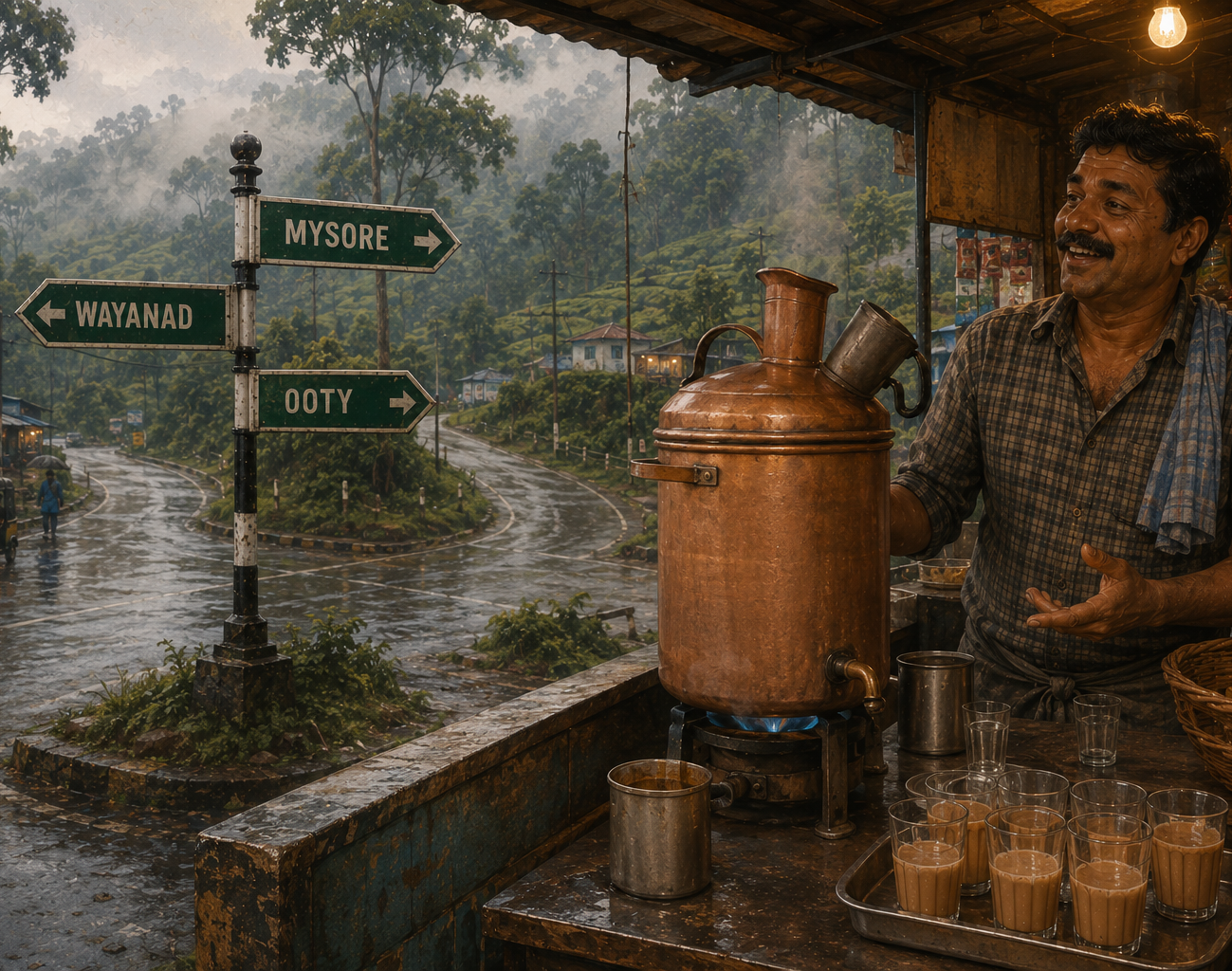
Tamil, Malayalam, Kannada — pick one, I'll switch mid-sentence anyway. Everyone here does.
— Kavi, market regular, fluent in confusionWhat to see
Drag or scroll sideways — each stop is timed from the town center.Pykara-Gudalur road viewpoints
Some of the best unplanned stops on this drive — no signage, just pull over.
Chembakolli tribal village
A working village with genuine, non-staged craft demonstrations.
Gudalur town market
Best in the early morning, when the produce trucks come down from the estates.
Tea/coffee estate visits
Several estates allow walk-through visits — ask locally, timings vary.
Where to sleep
Estate manager's bungalow
A colonial-era bungalow inside a working coffee estate.
Estate-view rooms
Smaller stays with direct estate access.
Town lodge
Functional, central, good base for onward travel.
Where to eat
Table by table, the temperature outside stops mattering.Kerala-Tamil border thali
A menu that genuinely can't decide which state it belongs to.
Market-side tiffin stall
Idli and vada, made fast, eaten faster.
Estate-road tea shop
Coffee here is as likely as tea — ask before you assume.
Local bakery stop
Simple baked snacks, good for the onward drive.
The Complete Picture
The Name and Where It Sits
Masinagudi is a panchayat town in the Nilgiris district of Tamil Nadu. Not Kerala. Not Karnataka. Tamil Nadu. It sits in the buffer zone of the Mudumalai Tiger Reserve. The reserve covers 321 square kilometers. The core area is off limits to private vehicles. The forest department controls access. The town name comes from the local topography. "Masin" refers to the red soil. "Gudi" means settlement. You see the red dirt the moment you cross the checkpost. It stains your shoes. It stains your tyres. You do not wash it off easily.
The People
The population is around 10000. The local economy runs on forest department jobs and tourism. The indigenous communities here are the Irulas and the Paniyas. They are different from the Todas and Badagas of the upper plateau. The Irulas know snake handling and honey collection. The Paniyas worked the forest as labourers during the colonial era. Both communities still live here. You hire them as guides. They know the forest better than any resort naturalist. You ask permission before you photograph anyone. You do not treat their home like your wildlife park.
The Safari Reality
People search for Masinagudi safari and Mudumalai tiger reserve timings. Here is the truth. The forest department runs the safaris. You book them at Theppakadu. Theppakadu is 10 km from Masinagudi town. The morning safari starts at 6 AM. The evening safari starts at 4 PM. You reach the booking counter one hour early. Tickets sell out fast. The forest department bans private vehicles inside the core reserve. You ride the forest department mini bus or the open gypsy. You do not drive your own car through the safari route. That is the law. You do not argue with the checkpost officer. People search for night safari in Mudumalai. The law bans night safaris in India. No resort can offer you a night safari inside the core reserve. If a resort promises this they are breaking the law. You report them. You only do the permitted morning and evening safaris. If someone tells you they can arrange a "special night drive" you walk away. You do not fund illegal activity. You do not risk a forest offence case. The Theppakadu Elephant Camp sits near the safari booking point. Mahouts feed the elephants at 8 AM. You watch from behind the wooden fence. You do not touch the animals. You do not feed them. You stand back. You take your photo. You leave.
The Night Closure Rule
The roads through the Mudumalai reserve close from 6 PM to 6 AM. This is a strict forest department rule. You do not drive after dark. If you miss the gate closing time you sleep in your car at the checkpost. There is no exception. There is no phone call that fixes it. You check the exact seasonal timings with the forest office before you travel. You do not assume. You verify. This rule exists because animals cross the roads at night. Elephants. Gaurs. Leopards. You hit one at 60 km per hour and both of you die. The gate protects them. It also protects you. You respect it.
District Rules. The Checkpost.
The Nilgiris district enforces a total ban on single use plastic. This is a district law. Not a Masinagudi town rule. Officers at the Masinagudi checkpost search your vehicle. They confiscate plastic bags. They confiscate disposable water bottles. They confiscate snack wrappers. They issue a fine on the spot. You strip all plastic packaging before you reach the foothills. You transfer snacks into cloth bags or steel containers. You carry steel or copper water bottles. You do not bring plastic into the forest. You do not argue. You comply.
Resort Rules You Must Follow
Resorts in Masinagudi sit inside the buffer zone. They do not host loud parties. They do not use bright floodlights. Bright lights confuse the wildlife. You keep your voice down after 8 PM. You do not walk outside your cottage at night. Elephants walk through resort compounds. You call the reception. You wait for the naturalist to escort you. You do not walk alone in the dark. You do not use your phone flashlight near the tree line. Water runs from bore wells and forest streams here. The supply is better than Ooty in summer. But you still conserve. You take short showers. You do not waste water in a forest zone.
The Economy
Forest department jobs keep most families employed. Safari driving. Checkpost staffing. Anti poaching patrols. Tourism is the second driver. Resorts, homestays, and local guides earn from the morning and evening safari crowds. There is no tea industry here. There is no horticulture export. The forest is the economy. You treat it accordingly.
LANDSCAPE
Masinagudi sits at roughly 900 meters above sea level. It is significantly lower than Ooty. It is significantly hotter. Summer temperatures hit 35 degrees. You do not carry woollens here in April. You carry water. The forest is dry deciduous. You see teak and rosewood and sandalwood. You do not see tea estates. You do not see eucalyptus plantations. The canopy thins in March. The undergrowth turns gold. That is when sighting rates peak. The animals move to water sources. You spot them easier. The Moyar River cuts a deep gorge between the Nilgiris plateau and the plains. The gorge drops nearly 300 meters. Vultures nest on the cliff faces. You drive to the Moyar viewpoint. You stay on the paved road. You do not walk down into the gorge. The terrain is unstable. The town itself is small. A single main road runs through it. Most buildings sit within 2 km of the forest checkpost. You can walk the entire town in twenty minutes. You do not need a car once you arrive. You need a car to get here. After that it sits parked. Climate runs hot and dry from March to May. Monsoon arrives in June and runs through September. October to February is cooler. Mornings drop to 15 degrees. That is the comfortable window for safari. You book morning slots in this season. The light is better. The animals are active.